
The launch of Polar Satellite Launch Vehicle (PSLV-C52) is scheduled at 05:59 hours on Monday from the First Launch Pad of Satish Dhawan Space Centre, Sriharikota, the Bengaluru-headquartered space agency said.
The panel will also recommend a fiscal consolidation road map for the central and state governments, study the impact of GST on the divisible pool, and propose performance-based incentives for states.

The growth in the contact-intensive portion of the economy trailed our expectation, highlighting how imperative it is for confidence to improve, either through accelerated vaccinations or otherwise, to drive a sustainable recovery in these sectors, asserts Aditi Nayar.

Prime Minister Narendra Modi on Monday batted for expansion of organic farming across the country.
'Why should our government opt for unproven technology that has been rejected by most countries across the globe?' 'Being dependent on any other nation to supply you seed for your good crops is another form of slavery.'

I suggest we build a Vigyan Mandir (Temple of Science) with the ambience of a place of worship, so that it becomes a destination for pilgrims. We should embed on its walls bronze plaques describing each scientist mentioned here along with about a dozen of our ancient mathematicians, recommends Professor Kalyan Singhal, historian of science and technology.

A closer look at the data reveals that a lot of the items are not part of this calculation. The notable ones include buffalo meat, marine exports, raw cotton, and plantation crops such as tea, coffee, rubber, etc.
Agri experts are meeting FinMin ministry officials on Monday to give their inputs on the Budget.

Niti Aayog CEO Amitabh Kant on Tuesday said it is difficult to carry out tough reforms in India and emphasised that more reforms are needed to make the country competitive in the global environment. Addressing a virtual event organised by Swarajya magazine, Kant said for the first time, the Centre has carried out hard reforms across sectors, including mining, coal, labour, agriculture, and the next wave of reforms must be pushed by the states.

Away from the distraction of its new high-profile politics, Wayanad's worries seemed very down to earth, discovers Shyam G Menon.

King Charles III, Britain's new monarch who ascended to the throne on the death of his mother Queen Elizabeth II, has a strong connection with India and its age-old traditions of Yoga and Ayurveda.

Prime Minister Narendra Modi on Monday said the Centre along with states is making efforts to control lumpy skin disease in cattle.
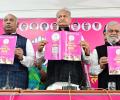
The fact that Gehlot has stayed relevant these five years with his populist schemes is one reason why he may beat incumbency in a state that votes for change every election, observes Ramesh Menon.

"Nari shakti" and women empowerment dominated the theme of tableaux of Kerala, Karnataka, Tamil Nadu, Maharashtra and Tripura at the Republic Day parade here on Thursday.
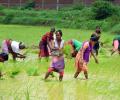
The 6.7% growth in Index of Consumer Sentiments in July 2022 is the highest since September 2021, explains Mahesh Vyas.

The immediate need is to put more money in the hands of agriculture-based and rural households to improve their purchasing power, says S Mahendra Dev.
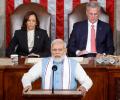
Here's the full text of Prime Minister Narendra Modi's address to a joint session of the United States Congress, delivered on Thursday.
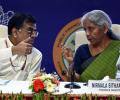
'...Market-linked debentures, high-value insurance, exemptions from capital gains by investment in real estate, etc.' 'So, there are a number of measures directed at collecting a fair share from higher income individuals.'

Given the many policy areas where the Centre and the states have not been seeing eye to eye in the last few years, it is time the Modi government convenes a meeting of the Inter-State Council, recommends A K Bhattacharya.
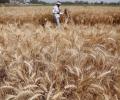
The surge in wheat export from India owing to the Ukraine crisis has once again demonstrated how farmers in states that have flexible marketing frameworks and low taxes benefit more from an emerging situation. The bulk of the wheat exported from India, trade and industry sources say, is being sourced at rates significantly higher than the state-mandated price of Rs 2,015 per quintal in Madhya Pradesh (MP), Uttar Pradesh (UP), and Gujarat - states which have low mandi taxes compared to Punjab and Haryana. This is not only benefiting farmers there but could also lead to significant savings for the states in procurement costs in the months to come.

It is regrettable that the IB has tried to devalue the expertise available both within the concerned ministry and in the scientific community by its allegations. Governments and NGOs in many western nations have not been accused of being 'anti-national' when they put their foot down on questionable practices by cash rich agri-business companies, says Rashme Sehgal.

According to state officials, the project envisages lifting of 17.40 thousand million cubic feet of water from river Thunga to Bhadra reservoir and 29.90 TMC from Bhadra reservoir.

A ramp-up in COVID-19 vaccination, healthy advance estimates of kharif (summer) crop and faster government spending were the factors which led to the revision, the agency said in a statement. It can be noted that after the 7.3 per cent contraction in 2020-21, there were expectations of a higher growth number in 2021-22.

The farmers' acceptance of the proposal came hours after the Centre sent them a letter suggesting December 30 as the date for the dialogue, against December 29 the protesting unions wanted.

The state government has started advising farmers to adopt 'cosmic farming' in which they need to chant 'Vedic mantra' for 20 days in the farm for better quality and quantity of their crop.

Indian farming was transformed after the mid-60s.
Among the key demands of agitating farmers has been a legal guarantee on minimum support price (MSP). The protest reached a crescendo when thousands of farmers from Punjab and elsewhere marched towards Delhi late last year and decided to block the main entry points once they were denied entry. The Centre, on its part, held 11 rounds of discussions with the protesters and even offered to amend some of the provisions without much success. With now one of their chief demands met, farmers have now moved on to force the government to concede on MSP.

Prime Minister Narendra Modi's call to make this decade a "techade" for India and the push for 5G, semiconductors and transformation through digital services is going to boost the technology sector in the country, industry players said on Monday. Modi, in his speech on the 76th Independence Day, touched upon all-round development of technology in the country, from 5G to push for electronic chips, laying of optical fibre cable (OFC) network across villages and enablement of digital entrepreneurship in villages through Common Services Centres, making the present decade as "techade" for India. Homegrown mobile devices maker Lava International's Chairman and Managing Director Hari Om Rai said electronics and technology sectors create about $4 trillion of revenue.

The report, which was submitted to the apex court on March 19, 2021, was made public on Monday. The three-member committee had also suggested many changes in the laws, including giving freedom to states to make Minimum Support Price (MSP) system legal.
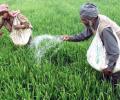
Kerala, Punjab, Telangana and Andhra Pradesh are among the major agriculturally important states that have banned the use of glyphosate citing its adverse impact on human health.

The Office of the United Nations High Commissioner for Human Rights, in a tweet said the rights to peaceful assembly and expression should be protected both offline and online.

Prime Minister Modi has certainly pulled back, and his political capital -- dependent as it is on an image that he knows best and never retreats -- may have taken a bit of a beating. But, equally, it is hard to say that the protesters have 'won', argues Mihir S Sharma.
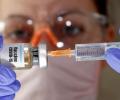
A model being considered is to have a combined cold chain approach - where the agricultural cold chain would be combined with vaccine cold chains.

'This confrontation could have been avoided by a less arrogant administration that initially listened, used whatever negotiating skills they had and tried to be more credible,' observes Ramesh Menon.
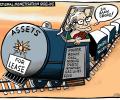
But use of that word -- privatisation -- is not encouraged. This seems to be a classic case of reforms through subtle signals, observes A K Bhattacharya.

Though the Bills of Punjab and Rajasthan have a lot of similarities, the one approved by the Chhattisgarh Assembly is structurally different. None of the three has tried to address a key demand of the agitating farmers in full, which is to make all payments below the MSP, within and outside mandis, illegal.

'The decision to supply free food grains is not an economically sound decision because the government will find it very difficult in future to charge anything for food grains.'
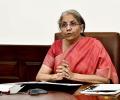
Finance Minister Nirmala Sitharaman is likely to strike a fine balance between being fiscally prudent and growth supportive when she presents her fourth straight budget on Tuesday, which is expected to have plans to boost spending to revive investment and create jobs. The Budget for the fiscal year starting April 1, 2022 is likely to raise spending on infrastructure to set the economy on a firmer footing. The stage for the Budget presentation was set by the Economic Survey stating that the government has the fiscal space to do more to support the economy that is forecast to grow at a healthy 8-8.5 per cent growth in the 2022-23 fiscal.

All laws have been modified to omit the domicile clause for property rights in the valley. This effectively means that anyone with enough money to spend can now technically buy property there, writes Sai Manish.

Godavari Dange, a school dropout who was widowed at the age of 19 is now changing the lives of farmers in her village and beyond.
